
Solar Windows
MIT engineers have invented what they call a solar concentrator; solar windows for the home.
Solar concentrators contain special dyes that help the windows absorb light differently.
The edges of the windows have energy cells that collect energy from light.
Solar concentrators to be used in solar windows:
The beauty of the above concentrator technology is that it does not need to move the track the sun, it can exist in a window and still harness sunlight efficiently.
According to Discovery Channel.com and Science Magazine, project leader Marc Baldo, claims the solar windows can obtain energy from 40% of the sunlight.
Dr. Baldo also claims that the concentrator can increase the ability of standard photovoltaic (PV) panels by 50%. This is huge, allowing photovoltaics to absorb 80% of the light energy that hits them.
According to MITs website, these windows or the dyes, will be available to the public within the next three years.
Dr. Baldos research team, includes EECS graduate students Michael Currie, Jon Mapel, and Timothy Heidel, and postdoctoral associate Shalom Goffri from the Research Lab of Electronics. They reported their discoveries in the magazine Science in June of 2008.
Thanks to the MIT Solar Concentrator invented by Dr. Baldo and his team, solar powered windows will be even cheaper and will be able to sell back more energy to the grid within the next three year.
miércoles, 4 de febrero de 2009

Hybrid Solar Lighting
Hybrid Solar Lighting
Hybrid solar lighting by Sunlight Direct is a bridge between conventional artificial lighting and fiber optics to achieve a healthier indoor environment and greater energy savings, possibly even making our nation up to 30% more self-reliant in electrical energy expenditures alone.
By a bridge, this means that the two systems are fully integrated in a technologically friendly way that has very little initial cost to the consumer or any major modifications to their already existing networks, has very important health advantages and are highly economic with incredible money and energy savings.
With hybrid solar lighting, the light of the sun hits down on a 48 inch parabolic mirror, focuses that light against a mirror that filters UV and IR light and is concentrated through over a 120 fiber optic cables that finally spit through a single spread-light fixture integrated directly into the traditional light fixture (florescent or incandescent) as an additional light (bulb).
Both incandescent lights and fluorescent light fixtures can be modified to usehybrid solar lighting technology. But in either case, the additional fiber optic luminescent is aesthetically pleasing and virtually unnoticeable to the human eye, unless inspected up close.
But the real advantages are in how the two systems play off ofone another; if it is just dawn for example, that reddish hue from the first rays of morning light will penetrate the parabolic system and this will illuminate the fiber optic cables with those exact same hues, color-code per color-code, everything except the UV and IR spectrums (which can be harmful to humans).
During the first morning hours, when the lights are turned on, the electrical lighting system will remain turned up to a low enough level that this natural lighting from the earths sun, can do its job with our biological clocks and wake us up as the saying goes, but still provide ample indoor lighting.
When the sun begins to rise during the day the levels of electrical light being consumed gradually go down, and from the zenith on toward dawn the electrical grid begins to pick up once again, without ever compromising those natural hues that are so essential to our human health.
By the end of the day, those hues of sunset remind those working inside what time it is, and that bedtime is close at hand, thereby creating a more humancycle biologically that is far closer to what Mother Nature originally intended for our species millions of years ago.
This conservation of electrical energy, through hybrid solar lighting would be fascinatingly important for retail stores, as tests have shown that this system can improve sales to up to 40%, while businesses that installed the system noted a 20% increase in employee productivity.
Overall, the United States would find that if everyone switched over to a hybrid solar lighting system, the consumption of electricity could be virtually reduced by 30%!
By the end of 2007, Sunlight Direct expects to have a working consumer model of this elite technology available to the public at large for a reasonable price and guaranteed for at least twenty years.
Hybrid Solar Lighting is making the future of our world a whole lot healthier and bringing the open sky back into our human lives.
Hybrid solar lighting by Sunlight Direct is a bridge between conventional artificial lighting and fiber optics to achieve a healthier indoor environment and greater energy savings, possibly even making our nation up to 30% more self-reliant in electrical energy expenditures alone.
By a bridge, this means that the two systems are fully integrated in a technologically friendly way that has very little initial cost to the consumer or any major modifications to their already existing networks, has very important health advantages and are highly economic with incredible money and energy savings.
With hybrid solar lighting, the light of the sun hits down on a 48 inch parabolic mirror, focuses that light against a mirror that filters UV and IR light and is concentrated through over a 120 fiber optic cables that finally spit through a single spread-light fixture integrated directly into the traditional light fixture (florescent or incandescent) as an additional light (bulb).
Both incandescent lights and fluorescent light fixtures can be modified to usehybrid solar lighting technology. But in either case, the additional fiber optic luminescent is aesthetically pleasing and virtually unnoticeable to the human eye, unless inspected up close.
But the real advantages are in how the two systems play off ofone another; if it is just dawn for example, that reddish hue from the first rays of morning light will penetrate the parabolic system and this will illuminate the fiber optic cables with those exact same hues, color-code per color-code, everything except the UV and IR spectrums (which can be harmful to humans).
During the first morning hours, when the lights are turned on, the electrical lighting system will remain turned up to a low enough level that this natural lighting from the earths sun, can do its job with our biological clocks and wake us up as the saying goes, but still provide ample indoor lighting.
When the sun begins to rise during the day the levels of electrical light being consumed gradually go down, and from the zenith on toward dawn the electrical grid begins to pick up once again, without ever compromising those natural hues that are so essential to our human health.
By the end of the day, those hues of sunset remind those working inside what time it is, and that bedtime is close at hand, thereby creating a more humancycle biologically that is far closer to what Mother Nature originally intended for our species millions of years ago.
This conservation of electrical energy, through hybrid solar lighting would be fascinatingly important for retail stores, as tests have shown that this system can improve sales to up to 40%, while businesses that installed the system noted a 20% increase in employee productivity.
Overall, the United States would find that if everyone switched over to a hybrid solar lighting system, the consumption of electricity could be virtually reduced by 30%!
By the end of 2007, Sunlight Direct expects to have a working consumer model of this elite technology available to the public at large for a reasonable price and guaranteed for at least twenty years.
Hybrid Solar Lighting is making the future of our world a whole lot healthier and bringing the open sky back into our human lives.
LED streetlight USS-70
LED streetlight USS-70
![]() The lamp USS-70 is intended for lighting of streets, roads, squares, warehouses and manufactures. Power consumption– 220 V-75W. It is substitution for mercury lamps OSRAM HQL STANDARD. It is irreplaceable in places, where energy saving and high reliability is needed. This lamp does not have stroboscopic effect, light power is not changed over the voltage range. Time of delay is 1 sec. USS-70 is made on the base of LEDs of Japanese company NICHIA, with 3 free power supplies. The housing of this streetlight lamp is made on aluminum, window is made on optical polycarbonate. The searchlight is fixed to any legs with tube diameter till 55 meters. All above-mentioned characteristics allows to get the highest reliability of streetlight LED lamp USS-70
The lamp USS-70 is intended for lighting of streets, roads, squares, warehouses and manufactures. Power consumption– 220 V-75W. It is substitution for mercury lamps OSRAM HQL STANDARD. It is irreplaceable in places, where energy saving and high reliability is needed. This lamp does not have stroboscopic effect, light power is not changed over the voltage range. Time of delay is 1 sec. USS-70 is made on the base of LEDs of Japanese company NICHIA, with 3 free power supplies. The housing of this streetlight lamp is made on aluminum, window is made on optical polycarbonate. The searchlight is fixed to any legs with tube diameter till 55 meters. All above-mentioned characteristics allows to get the highest reliability of streetlight LED lamp USS-70


 The lamp USS-70 is intended for lighting of streets, roads, squares, warehouses and manufactures. Power consumption– 220 V-75W. It is substitution for mercury lamps OSRAM HQL STANDARD. It is irreplaceable in places, where energy saving and high reliability is needed. This lamp does not have stroboscopic effect, light power is not changed over the voltage range. Time of delay is 1 sec. USS-70 is made on the base of LEDs of Japanese company NICHIA, with 3 free power supplies. The housing of this streetlight lamp is made on aluminum, window is made on optical polycarbonate. The searchlight is fixed to any legs with tube diameter till 55 meters. All above-mentioned characteristics allows to get the highest reliability of streetlight LED lamp USS-70

lamp USS-150M
 The lamp USS-150M is intended for lighting of streets, roads, tunnels, petrol stations, squares, warehouses, stocks and manufactures. Power consumption– 220 V -150 W. It is substitution for mercury lamps DRL-400.
It is irreplaceable in places, where energy saving and high reliability is needed, under higher vibration, moisture. The lamp has not stroboscopic effect, light power does not change during power band. Operation time is les then 1 second.
Lamp USS-150М is made on the base of LEDs of Japanese company NICHIA, with 6 independent power supplies. The housing of this streetlight lamp is made on aluminum, window is made on optical polycarbonate. The searchlight is fixed to any legs with tube diameter till 50 meters. By request these lamps can be completed by wall of ceiling binding. As optional, they can be completed by light sensors for automatic on/off for sunset/sunrise.
Streetlight LED lamps extra service is not necessary during it’s life time (more then 20 years), only periodical washing by water sheet.
Height of fixture, meters
Lightness per axle, LUX for USS-150
4...................... 221
6..................... .98.4
8..................... .55.4
10......................35.4
12......................24.6
Time of day-to-day operation LEDs
lamp, years 23*
Light flux, Lm 11500
Angle of light emission, 2Ô 0.5 degree 120**
Voltage, V 120-280
Power consumption, W 145
Emission band sunny white
Guarantee period, month 24
Overall dimensions, mm 820*350*65
Weight not more, kg 17
Moisture protection, IP not less 67
Environment temperature from –60ºC to +40ºC
sábado, 24 de enero de 2009
tostador solar de café
Un tostador solar para granos de café, mediante aire sobrecalentado tuesta granos de café.
el aire se calienta en el foco del colector y se dirige a la cámara de tostado mediante un sistema de ductos flexibles,

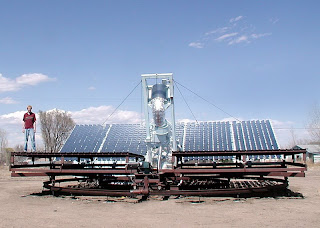
el aire se calienta en el foco del colector y se dirige a la cámara de tostado mediante un sistema de ductos flexibles,


sábado, 17 de enero de 2009
lámpara de emergencia led
300-3-T3a.jpg)
Components Solar Panel
Capacity 10W
Working Life 15 Years
Work and Vacancy Proportion 1:3
Luminance Proportion at day and night 2:1
Flashing Frequency 1 Hz
Accumulator Battery 7Ah/12V
LED 2500 mcd
USo 80,000 horas
Working Time of Continuous Rainy Day 4 Days
Operating Temperature (℃) -30~+40℃
Operating Voltage 12V AC, 50HZ/60HZ
Dimension (mm) 560x590x780
luminarias solares

Esta Tecnología puede ser utilizada en todos lugares de industria, comercio y uso particular y funciona a partir de la generación de energía eléctrica por medio de paneles solares fotovoltaicos, que durante el día almacenan dicha energia, en un banco de baterías.
Para que durante la noche alimente la luminaria, por el número de horas en que se dimensione el tamaño del sistema y sus reservas.
Cuenta con una fuente de iluminación de “leds” (tecnología de punta) de alto brillo, con una garantía de 10 años y una vida útil superior a 100,000 horas; su diseño permite instalarla en poste, en muros o donde se desee, etc.
Usa como fuente de energía la radiación solar, y es totalmente programable en el encendido y apagado, con opción a ser escalable y crecer en capacidad, ademas no contamina, ya que de cada 1,000 watts en Mexico, que se consumen de la CFE, mas de 800 watts, provienen de termoeléctricas que contaminan para generar la electricidad.
Las luminarias fotovoltaicas son totalmente independientes, no necesitan de cableados, ideal para usarse en lugares donde no existe el servicio de la electricidad convencional. La lámpara de “leds” de alto brillo, emite luz blanca de día de 3000 a 4000°k, que permite iluminar y distinguir con claridad los colores de los objetos iluminados. Colocada en un poste a una altura de 6 m. alcanza a emitir un cono de luz de aproximadamente 25 m. de diámetro, en su modalidad de 32 w. La pureza de su luz marca la diferencia contra la emitida por el VSBP y otro tipo de luminarias.
Para este nuevo proyecto nuestro, hemos detectado un gran nicho de oportunidad de ahorro de energía y de recursos financieros en iluminación publica comercial, ya que la combinación del bajo consumo de energía con la larga vida de las lámparas LED, abate los costos tanto de pago de consumo eléctrico como de lámparas en un tiempo promedio de 10 años o menos; para comparar gastos se deben contemplar ambos parámetros.
Lo anterior permite grandes ahorros en gastos de alumbrado publico con inversiones de casi cero, en reemplazo de bombillas de alto consumo.
Suscribirse a:
Entradas (Atom)